Again, Howdy from London! Week six has come and gone, and our time here continues to fly by at a rapid pace.
Monday, February 11:We had our weekly British Life and Culture class with Professor Hertz. This week’s topics covered the history of development of the British economic systems involving in large part the East India Trading company. He took us through the timeline of commerce and trade, as far as the ‘Asian Triangle’ to the American Colonies, trade destinations that eventually led to the founding of the Great British Commonwealth. Following our class period, our professor always takes us on a walk around London to a sites of importance that were raised in his lecture. This week, he led us through the Covent Garden area to see the various markets and famous shops. Afterwards, we continued on to the National Gallery. The National Gallery is one of the most visited museums in the world. The artwork on display is owned by the government for the benefit of all British people. On display are works by Leonardo da Vinci, Vincent Van Gogh, Rembrandt, and many others. The days we spend with Professor Hertz are always so interesting, not only because of his excitement regarding the material he covers, but also because he is showing us amazing glimpses into world history. We all have developed a much greater appreciation for this country and its rich heritage.

Tuesday, February 12:Our day started by meeting Professor Rodgers in a suburb south of London called Brixton. We had a private tour of the town by Ms. Nicola Whyte, who works with the Borough of Lambeth. Brixton is very different from London as a whole, in that it has a very strong Rastafarian culture. Its residents are primarily from the Caribbean, and Jamaica in particular.

From the food markets and jerk chicken restaurants, to the flags and murals around town, it is clear to see their cultural pride in the city. From a construction standpoint, they have a small developmental scheme that was very interesting. They built an entire structure out of old shipping containers. This is complete with coffee shops, food vendors, and even small business office spaces.

The project, Pop Brixton, was essentially built as a temporary structure to encourage small business growth. It was only intended to be up for two years but has already made it past its fourth year. After our Brixton tour and a quick stop for lunch, we made our way to our construction site for the week, Embassy Gardens.

Ballymore Construction, Ltd. is building a massive residential project located adjacent to the new US embassy in Nine Elms along the Thames.
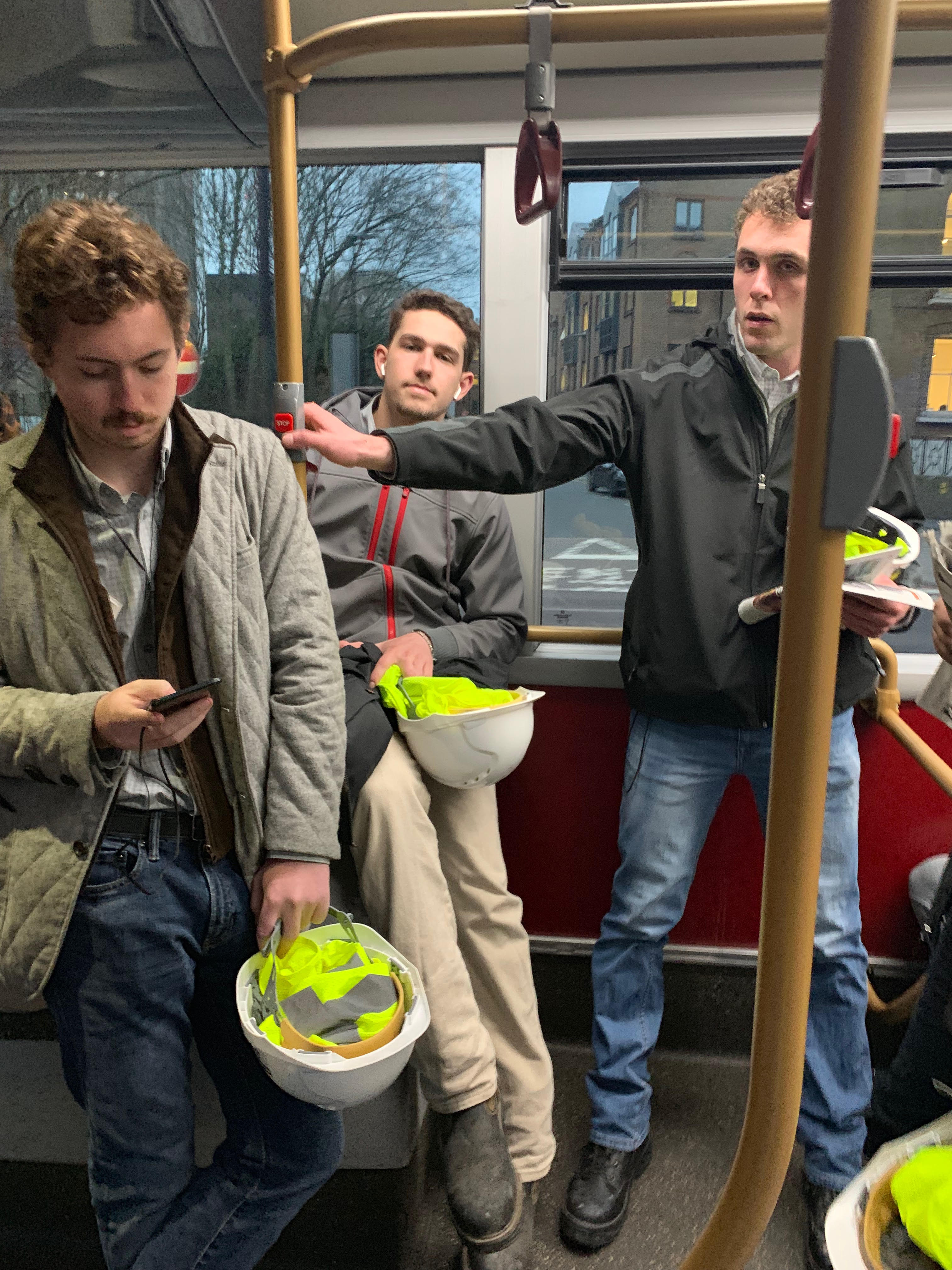
The project is called The Embassy Gardens. The project as a whole will include up to 1,750 new homes along with office and flexible workspaces. This is spread over eight building plots rising up to 23 stories in height. In the 15-acre development there will be a number of different areas for residential, commercial, and retail space, including the world-famous sky pool.

The sky pool is the first of its kind in the world spanning between two separate buildings 15 stories high. It was quite the sight to see the scaffolding all set up constructing this seemingly impossible structure.

Wednesday, February 13:Today was our weekly classroom time with Professor Rodgers. Class took place as normal, discussing different aspects of construction law, focusing this week on Chapter 23 in our book covering dispute resolution. This included all the common uses in our legal system back home including mediation, arbitration, dispute resolution boards, and finally litigation. We even got a touch of Professor Rodgers favorite, adjudication, which is a form of dispute resolution only found in British construction disputes. After some time in lecture we had a guest speaker from Carey Engineering, Mr. Michael O’Shea, PE. Earlier in the semester we toured the former U.S. Embassy that is being renovated into a hotel by Carey Engineering. Mr. O’Shea is the project manager. The same representatives that showed us the construction site came back and gave us a lecture on risk management. He first defined risk and went over the majority of the risks he sees on a day to day basis. We discussed how to eliminate or at the least substitute the risk. Mr. O’Shea then took us through the hierarchy of risk management and the phases of project risk management: contract risk, design risks, commercial risk, and operational risks. It was much more interesting to hear the different techniques used by a professional on a current project as opposed to reading it out of a textbook.

Thursday Feb. 14:The group started off Thursday morning by visiting Trowers & Hamlin LLP(T&H), an international law firm that specializes in construction litigation. During our time at Trower & Hamlin LLP we received an extremely informative presentation about adjudication given by T&H Partner Theresa Mohammed and T&H Solicitor Zoeyah Shaheen. The presentation thoroughly covered the adjudication process, a statutory form of dispute resolution. Adjudicationis a procedure for resolving disputes without resorting to the lengthy and expensive court procedures. Adjudication is a process that was introduced in the UK by the Housing Grants, Construction and Regeneration Act of 1996(Construction Act 1996). This act mandates the right to utilize this form of alternative dispute resolution in construction contracts. The main goal of the adjudication process is “keep the money flowing” by having disputing parties present their positions to a third party decision maker who resolves the dispute within 28 days. This process is a statutory right, meaning the parties cannot contract out. Construction disputes are generally complex and expensive to litigate, the adjudication process is designed to cut through all that complexity and offers fast and practical solution.

Following our visit at Trowers and Hamlins, the group headed down to the Royal Courts of Justice. We were fortunate enough to have the opportunity to sit in on case being tried. During the proceeding the judge gave the two opposing parties an opportunity to come to an agreement amongst themselves. The two parties then exited the courtroom and during that time our group was able to speak with the courtroom clerk and gather more information regarding the background of the case. The clerk was welcoming and willing to answer the questions we had surrounding the proceeding and case. Being able to sit in on a case and watch how proceedings are carried out was a neat opportunity.

Friday Feb. 15: On Friday the group met up bright and early at Liverpool Station to hop on a train and head to Norwich for the day. Norwich is an old city in the north east of England close to the North Sea. The weather in Norwich couldn’t be any better. The sun was shining and the temperature was in the high fifties, which was a pleasant change from what we had been experiencing.

The first thing we did in Norwich was grab some food as it had been a long train ride and we were starving. We ended up at Cote Brasserie, a French cuisine restaurant Professor Rodgers wanted us to experience. This was definitely my highlight of the day; the food was delicious. After we finished up at the restaurant we headed to Norwich Castle. The castle was founded in the medieval times by William the Conqueror following the Norman conquest of England. We then explored the castle at our own leisure and wandered off to explore more of the town before we headed back to London.

 The Angel Adventure